July 2026
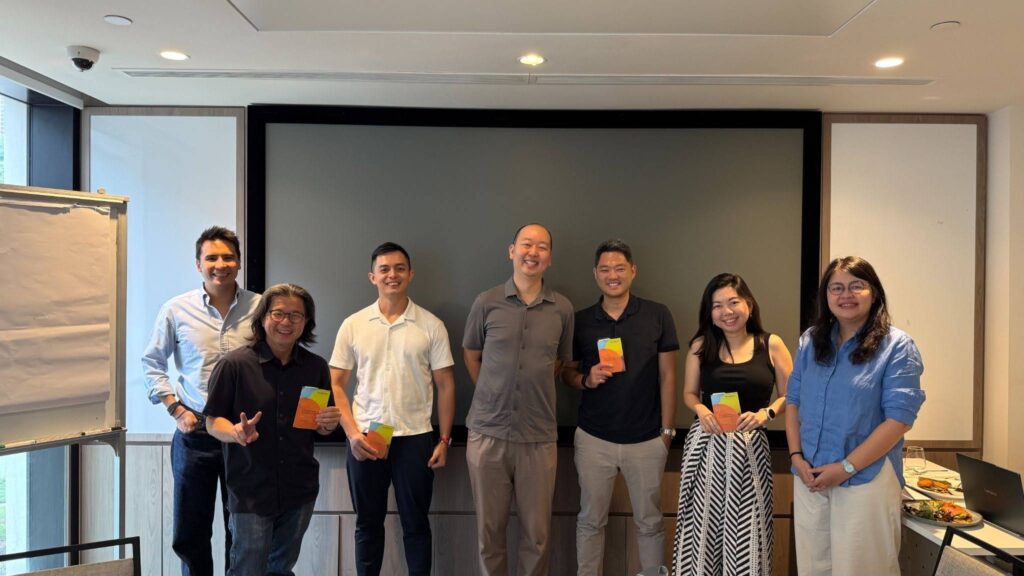
Attendees:
|
Paustina Chou
sgCarMart
|
Ryne Cheow
NTUC FPG
|
Yi-Wei Ang
PropertyGuru
|
|
Alex de Leon
PropertyGuru
|
Weibin Tay
CDL
|
Christopher Chew
Cisco
|
Overview
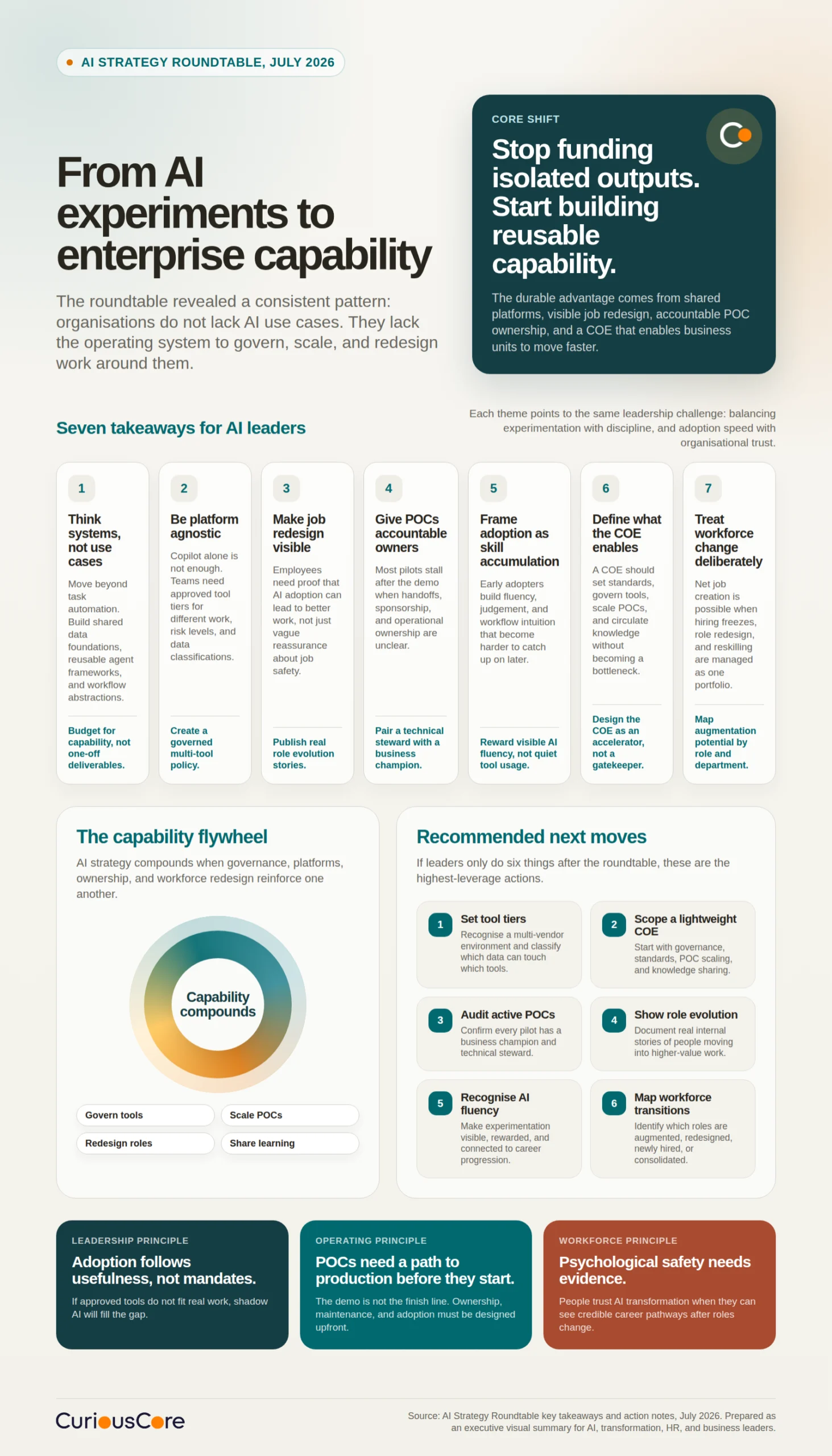
This roundtable brought together AI and transformation leaders across Singapore’s property, automotive, financial services, and technology sectors. Seven shared themes emerged from the discussion — each reflecting a tension that enterprise AI programmes commonly face: the pull between quick wins and structural change, between tool proliferation and governance, and between workforce anxiety and opportunity. These notes capture what was said, what it means, and what to do about it.
1. Think Systems, Not Use Cases
What came up
There is a persistent bias — sometimes called “Maslow’s hammer” — toward over-indexing on narrow, well-defined use cases (cost cutting, revenue uplift) rather than investing in scalable platforms and infrastructure. Organisations that focus only on use cases tend to end up with fragmented automation that doesn’t compound over time.
So what
The more durable question isn’t “what task can AI automate?” but “what system can we build that makes us structurally better over time?” This means prioritising shared data foundations, reusable agent frameworks, and workflow abstractions that can be applied across departments — not just a succession of bespoke point solutions.
Action
When evaluating AI initiatives, ask whether the output is a capability or just a deliverable. If a project cannot be extended, reused, or built upon, it likely belongs in a backlog — not a budget line.
2. Be Platform Agnostic — Copilot Is Not Enough
What came up
Several attendees noted their organisations had moved away from a single-platform mandate. Real-world usage patterns show that different teams need different tools — enterprise models (e.g., Gemini) for compliant, high-volume tasks, and frontier models (e.g., Claude, ChatGPT) for complex reasoning and drafting. Shadow AI — unapproved use of external tools — is already happening and creates compliance risk when unmanaged.
So what
Forcing a single vendor (Copilot, or any equivalent) onto all employees creates a false sense of coverage. Teams will route around restrictions if the designated tool doesn’t meet their needs — producing ungoverned usage that’s harder to audit than a structured multi-tool policy.
Action
Establish a tiered tooling policy: a governed enterprise tier for sensitive data, and an approved frontier tier for productivity-oriented tasks. Define which data classifications can touch which tools. Treat this as a living policy — AI tooling is evolving faster than annual policy cycles.
3. Make Job Redesign Visible to Build Psychological Safety
What came up
Employee resistance remains one of the most cited barriers to AI adoption. The fear isn’t irrational — many roles will change materially. What’s missing in most organisations is a credible, visible narrative about what happens to people after their role changes: what new skills they’ll gain, what new responsibilities they’ll take on, and how AI-enabled roles are progressing within the organisation.
So what
Psychological safety doesn’t come from reassurance alone — it comes from evidence. When employees see peers transition from routine tasks to higher-value work and advance their careers as a result, adoption accelerates organically. The problem is that most organisations focus change management energy on launching AI tools rather than on communicating career trajectories post-adoption.
Action
Develop and publicise 3-5 internal case studies of role evolution — real people, real progression stories. Pair AI rollouts with visible reskilling pathways, not just training hours. Consider making job redesign frameworks available at the business unit level so managers can co-design transitions with their teams.
4. POCs Die Without Decentralised Ownership
What came up
The group noted that approximately 90% of proof-of-concept projects fail to reach enterprise-scale production. The primary culprits: lack of a centralised scaling function, unclear handoff ownership between the team that built the POC and the team expected to operate it, and insufficient internal advocacy to keep momentum alive post-demo.
So what
A POC without a named owner and a committed business unit sponsor is a time-bounded experiment, not a programme. The energy that builds a POC rarely transfers automatically into the energy required to operationalise it. Decentralised AI champions — people embedded in business units who understand both the technology and the domain — are the connective tissue that POCs currently lack.
Action
For every active POC, assign a dual ownership model: a technical steward (responsible for build and maintenance) and a business champion (responsible for adoption, benefit realisation, and escalation). Make both roles explicit, resourced, and accountable in project governance.
5. Frame Early Adoption as Skill Accumulation, Not Risk
What came up
The dominant employee narrative around AI is still risk-centric: “What happens to my job?” A more effective counter-narrative — one that resonated in the discussion — reframes adoption as an opportunity to accumulate a new class of capability that will be universally valuable. The message isn’t “your job is safe” (which may not be fully true); it’s “the people building fluency with these tools now will be the ones with options later.”
So what
Early adopters build compound advantages — they develop intuitions, workflows, and domain-specific AI applications that late adopters will have to rebuild from scratch. Organisations that make this visible create internal pull rather than top-down push. The narrative shift from “get on board or else” to “get on board while the window is open” is subtle but meaningfully different in how it lands.
Action
Build an internal “AI fluency” track — visible, rewarded, and optional at first. Recognise early adopters publicly. Share metrics on how AI-fluent employees are performing relative to peers (productivity, output quality, career velocity) to let the data make the case.
6. Define the Role of a Centre of Excellence (COE)
What came up
Multiple attendees referenced a Centre of Excellence or equivalent governance body as a critical missing piece in many organisations. The COE’s value isn’t in centralising AI decisions — that creates bottlenecks — but in providing the infrastructure, standards, and guardrails within which business units can move faster and with more confidence.
So what
Without a COE (or a Business & Technology Transformation Committee as an alternative structure), organisations end up with: ungoverned shadow IT, duplicate tooling spend, inconsistent data practices, and no mechanism for scaling successful POCs. The COE bridges local innovation and enterprise-grade reliability. Its mandate should be enabling, not controlling.
Action
Scope a COE around four functions: (1) Tool governance — maintain the approved tooling registry and onboarding process; (2) Standards — define prompt engineering, data handling, and output review standards; (3) Scaling — provide the technical capacity to take successful POCs to production; (4) Knowledge sharing — run a regular internal forum where business units exchange what’s working. Staff it with both technical and business representation to avoid it becoming a pure IT function.
7. Net Job Creation Is Real — But Only With Deliberate Enablement
What came up
The fear that AI leads purely to headcount reduction is not borne out by more advanced deployments. Organisations further along the adoption curve are shifting engineers from traditional execution roles into product-oriented roles that partner directly with business units. A hiring freeze paired with internal retraining is emerging as the preferred workforce strategy — maintaining headcount while increasing capability density.
So what
The distinction between “AI replacing jobs” and “AI changing jobs” is consequential for how organisations recruit, retain, and develop talent. Net job creation is achievable — but it doesn’t happen automatically. It requires deliberate investment in capability building, structured role redesign, and a willingness to absorb a productivity dip during transition.
Action
Audit current roles for AI-augmentation potential rather than replacement potential. Build a skills transition map that identifies which roles can evolve (and into what), which require new external hires, and which may be consolidated over time. Make this map visible to employees and managers — not as a threat, but as a planning tool.
Cross-Cutting Themes
| Theme |
Core Tension |
Resolution Direction |
| Use cases vs. systems |
Speed of delivery vs. long-term leverage |
Invest in reusable platforms, not just outputs |
| Platform lock-in vs. tool freedom |
Governance vs. adoption |
Tiered tooling policy with clear data classification |
| Top-down rollout vs. grassroots adoption |
Control vs. engagement |
Empower champions, make adoption visible and rewarded |
| POC culture vs. production discipline |
Experimentation vs. scale |
Dual ownership model for every initiative |
| Job security narrative vs. capability narrative |
Fear vs. opportunity |
Lead with skill accumulation, not job protection |
| Centralised COE vs. decentralised BU innovation |
Efficiency vs. agility |
Enabling COE, not gatekeeping COE |
| Workforce reduction vs. workforce evolution |
Cost vs. capability |
Reskilling + hiring freeze over redundancy |
Recommended Next Steps
- Establish a tooling policy that formally recognises a multi-vendor AI environment and sets clear data classification rules per tool tier.
- Launch a COE scoping exercise — even a lightweight version with 2-3 people — to address shadow AI governance and POC scaling immediately.
- Run a POC audit: for every active proof of concept, confirm whether there is a named business champion and a technical steward. Sunset those without both.
- Commission 3-5 internal role evolution stories for change management collateral — real transitions, not hypothetical personas.
- Design an AI fluency recognition programme that makes early adoption visible and career-relevant, not just voluntary and informal.
- Build a workforce skills transition map at the department level to shift the conversation from “who gets replaced” to “what do we become.”