Schedule a call
-

The New Age of Tech Careers: Top Skills You Need for 2026 and Beyond

In this article

By 2026, “working in tech” will no longer mean sitting in a software engineering team writing code all day. Tech is bleeding into every function and industry, from operations and marketing to customer service, finance and public sector roles. Careers are becoming more fluid, hybrid and skills-based, and professionals who succeed will be those who combine digital confidence with strong human and strategic capabilities.

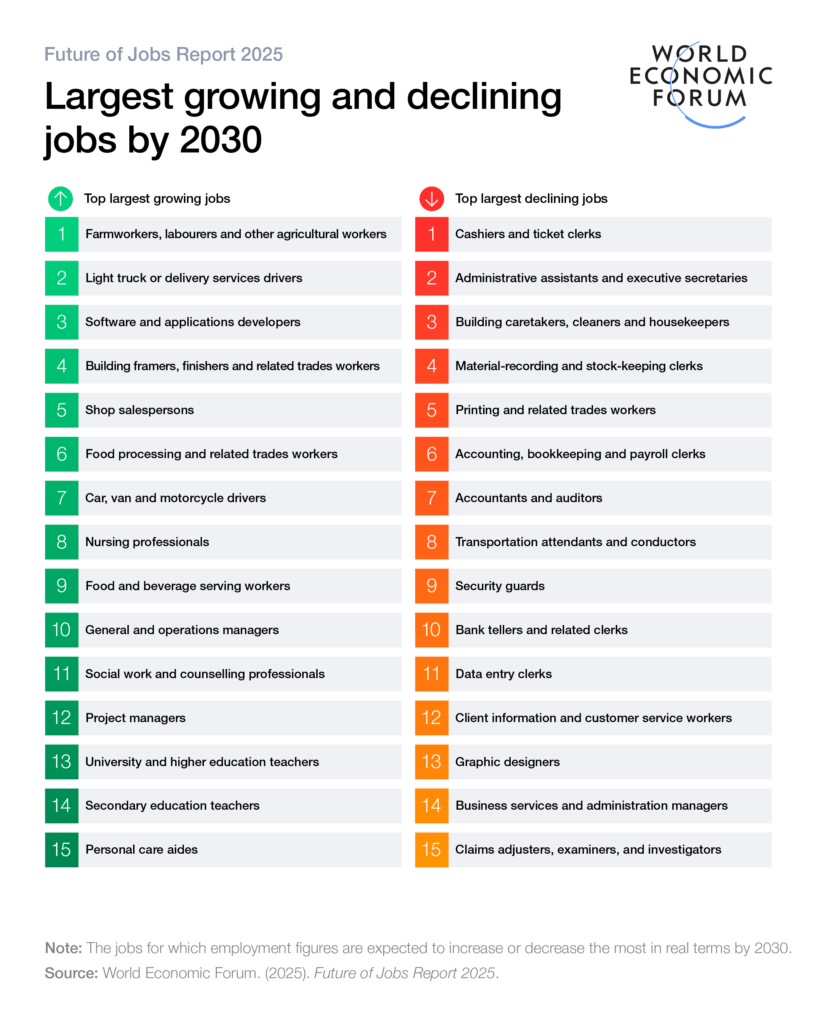
The World Economic Forum’s Future of Jobs Report 2025 captures this shift by showing that technology-related skills such as AI and big data, networks and cybersecurity, and technological literacy are among the fastest-growing capabilities employers expect to need by 2030. At the same time, analytical thinking, creative thinking, resilience, flexibility and leadership are named as the core skills most in demand, demonstrating that thriving in the new age of tech careers requires both technical and human strengths.​

From job titles to skill portfolios

A decade ago, people spoke about “getting into tech” as if it were a single, clearly defined destination. Today, the tech landscape looks more like a web of overlapping disciplines: UX, product management, data, AI, cybersecurity, cloud, digital marketing, service design and more. Careers are increasingly built around evolving portfolios of skills rather than fixed job titles.

This shift is being accelerated by rapid advances in AI and automation, which are reshaping how work is done rather than simply replacing jobs one-for-one. Many roles now blend responsibilities that used to be siloed; for instance, a product manager might be expected to run user interviews, interpret data dashboards, understand AI capabilities and facilitate cross-functional workshops, all in the same week. The professionals who will stand out in 2026 and beyond are those who can move across these boundaries with confidence.

Why the demand for tech skills is exploding

Several powerful forces are driving the surge in demand for tech-related skills. First, generative AI has gone mainstream: companies of all sizes are experimenting with AI copilots, chatbots, code assistants and content generators to boost productivity and creativity. Second, organisations are accelerating digital transformation programmes, migrating to the cloud, automating workflows and rethinking customer journeys end-to-end. Third, green and sustainability agendas are pushing industries to redesign products and operations, often supported by data and digital platforms.​

The World Economic Forum’s analysis of employer expectations highlights that AI and big data now top the list of fastest-growing skills globally, closely followed by networks and cybersecurity and general technological literacy. This does not mean everyone must become an AI engineer, but it does mean that being able to understand, question and use AI and data tools is becoming a baseline expectation for many professional roles.​

The core tech skills you’ll need by 2026

Looking ahead to 2026 and beyond, several technical and digital skill domains stand out as particularly valuable across a wide range of careers. These areas matter whether you work directly in a tech team or in a role that increasingly relies on technology for decision-making and delivery.

Key technical skill clusters include:​

  • AI and data literacy
    Understanding how AI systems are used in practice, what they can and cannot do, and how to interpret AI-generated outputs is becoming essential. This includes familiarity with generative AI tools, data dashboards and analytics platforms, rather than deep expertise in writing algorithms.
  • Networks, cybersecurity and digital safety
    As more services move online and into the cloud, every professional has a part to play in keeping systems and data secure. Awareness of basic cyber hygiene, access controls, data protection and incident response is increasingly valuable, particularly in regulated sectors.
  • Technological literacy and tool fluency
    Employers are looking for people who can evaluate new digital tools, learn them quickly and integrate them into existing workflows. This covers everything from collaboration platforms and automation tools to low-code app builders and AI copilots.​
  • Automation, scripting and low-code
    You do not need to be a full-time developer to benefit from basic scripting, workflow automation or no-code platforms. The ability to connect tools, streamline processes and build simple applications is becoming a powerful advantage in operations, marketing, HR and many other functions.​

Having at least one strong “spike” in a technical area, supported by broad digital fluency, will make it easier to pivot between roles and take on more strategic responsibilities over time.

The human skills that make you irreplaceable

Technology alone does not deliver value; people do. As AI takes on more routine and repetitive tasks, human skills that are hard to automate become even more valuable. The Future of Jobs Report 2025 underlines this by placing analytical thinking, resilience, flexibility, leadership, social influence and creative thinking among the top core skills employers need between now and 2030.​

For tech-enabled careers, some of the most important human skills include:

  • Analytical thinking and problem-solving
    Being able to break down complex problems, weigh trade-offs and use evidence to make decisions is consistently ranked as the number one skill employers look for. This is crucial in roles such as product management, UX, data analysis and operations.​
  • Creative thinking and experimentation
    Creativity is not limited to designers. It is about generating novel ideas, testing hypotheses quickly and reframing challenges to uncover better solutions. Commentators on the WEF data point out that analytical and creative thinking together act as “twin engines of innovation” in the modern workplace.​
  • Resilience, adaptability and learning agility
    Tech environments change quickly: tools evolve, priorities shift and teams reorganise. Employers therefore value people who can adapt, bounce back from setbacks and learn new skills continuously.​

Collaboration, communication and leadership
With cross-functional squads and hybrid working now the norm, professionals must be able to collaborate across disciplines, influence stakeholders and communicate clearly with both technical and non-technical audiences. These skills are particularly important for UX designers, product managers, project leads and anyone driving digital change.​

AI as a co-pilot, not a competitor

One of the biggest mindset shifts required for future tech careers is learning to work with AI rather than against it. AI is increasingly acting as a co-pilot that can summarise information, generate first drafts, propose design variations, write code snippets and surface patterns in data. Professionals who know how to guide, critique and refine AI outputs will be able to move faster and focus more on high-impact thinking.​

This requires three layers of capability:

  1. Tool proficiency – knowing how to use AI interfaces effectively, including prompt design, structuring tasks and combining multiple tools in a workflow.
  2. Critical judgement – being able to spot errors, biases or gaps in AI outputs and applying domain expertise to correct them.
  3. Ethical and strategic awareness – understanding when AI should and should not be used, and how it affects privacy, fairness, safety and customer trust.​

By 2026, AI literacy will no longer be a “nice to have” but a fundamental component of digital professionalism across many careers.

UX, product and data as “bridge” careers

For many mid-career professionals, the most realistic way into the tech world is through roles that sit at the intersection of technology, business and users, rather than deeply specialised engineering tracks. UX design, product management and data roles are prime examples of this.

  • UX design brings together research, psychology, design, experimentation and collaboration to create usable, meaningful experiences for customers and employees. It relies heavily on empathy, analytical thinking, creative problem-solving and technological literacy—all skills identified as increasingly important in the 2025–2030 period.​
  • Product management requires balancing customer needs, business strategy and technical constraints. Product managers draw on analytical thinking, leadership, communication, resilience and a strong grasp of digital tools and data.​
  • Data roles span everything from business intelligence to analytics and data product management. They combine AI and data literacy with storytelling, stakeholder influence and operational awareness.​

These “bridge” careers offer accessible pathways into tech for people coming from marketing, operations, customer service, consulting and other backgrounds, provided they are willing to invest in upskilling and project-based practice.

How to future-proof your tech career

Knowing which skills matter is only the first step. The next challenge is designing a realistic plan to build and demonstrate those skills over the next 12–24 months. A practical approach could look like this:

  1. Audit your current skills
    Map what you already do well against the clusters above: AI and data literacy, general tech fluency, analytical and creative thinking, resilience and leadership. Identify two or three high-priority gaps that would unlock the biggest career opportunities.
  2. Choose one or two focus areas
    Rather than trying to learn everything at once, select one technical area (for example, UX foundations, data basics or GenAI for workflows) and one human skill (such as storytelling, leadership or facilitation) to improve deliberately.
  3. Invest in structured learning
    Short, intensive courses and workshops can accelerate your progress far more effectively than piecing together random tutorials. Look for programmes that integrate project-based work, feedback from practitioners and clear learning outcomes aligned with industry needs.​
  4. Apply your skills to real problems
    Use your current role, side projects or volunteer opportunities to apply new capabilities. Build prototypes, redesign processes, run small experiments or automate repetitive tasks and document the impact.
  5. Curate a portfolio and narrative
    Whether you want to move into UX, product, data or AI-enabled leadership, create a portfolio or case-study deck that showcases how you approach problems, use tools and deliver outcomes. Hiring managers increasingly look at evidence of thinking and impact, not just certificates.

How CuriousCore supports future-ready professionals

This is where organisations like CuriousCore come in. Based in Singapore, CuriousCore focuses on helping mid-career professionals and teams build the exact mix of UX, product and GenAI skills that employers are prioritising for the years ahead. Courses are designed and taught by practitioners, with a strong emphasis on applied learning, real projects and career support rather than purely theoretical content.​

The User Experience Career Accelerator (UXCA) is tailored for people looking to transition into UX or strengthen their design capabilities in tech-enabled roles. Over several months, participants learn how to conduct user research, synthesise insights, create prototypes, run usability tests and build a professional portfolio, all under the guidance of experienced mentors. This aligns closely with the demand for analytical thinking, creative thinking, empathy, collaboration and technological literacy highlighted in recent labour-market research.​

CuriousCore’s GenAI workshops: Lead, Solve, Build

To address the rapid rise of AI and data-related skills, CuriousCore has launched a series of in-person GenAI workshops for different levels of responsibility: Lead with GenAI, Solve with GenAI and Build Apps with AI (Build with GenAI). All three are eligible for SkillsFuture Credit and WSQ subsidies, making them accessible to self-sponsored professionals and company-sponsored learners in Singapore.​

  • Lead with GenAI is ideal for senior leaders and decision-makers who need to design AI strategies, evaluate risks, shape governance and drive adoption across their organisations. Participants learn frameworks for ethical and effective AI use, connecting directly to the leadership, strategic thinking and digital literacy skills that employers consider essential for the coming decade.​
  • Solve with GenAI targets product and business leaders in middle management, focusing on using GenAI to improve research, map workflows, redesign processes and solve real business problems. The workshop emphasises analytical thinking, critical judgement and practical experimentation with AI tools, helping participants move from ad-hoc usage to structured, repeatable value creation.​
  • Build Apps with AI (Build with GenAI) is a hands-on workshop where participants use no-code and low-code platforms to design and deploy AI-powered applications within a day. This course is particularly valuable for UX, product and business professionals who want to move beyond ideation and actually ship working prototypes, reinforcing the automation and technological literacy skills flagged as fast-growing globally.​

Across all these programmes, CuriousCore’s teaching approach is strongly applied: learners work on real use cases, receive personalised feedback and are encouraged to bring their own industry challenges into the classroom. This ensures that new skills translate directly into workplace impact.​

Conclusion: Designing your next step

The new age of tech careers is not about chasing the latest buzzword or trying to memorise every new tool that hits the market. It is about building a resilient foundation of skills—analytical and creative thinking, AI and data literacy, UX and product awareness, collaboration, resilience and leadership—that will remain relevant even as specific technologies change.

If you are serious about staying employable and impactful in 2026 and beyond, the most important step is to treat learning as a continuous, intentional part of your career. That might mean enrolling in a UX bootcamp, joining a GenAI workshop, seeking out a mentor, or carving out weekly time to experiment with AI tools and document your results. Providers like CuriousCore offer structured, practitioner-led pathways that align closely with what employers say they need, helping you turn vague aspirations into concrete, market-ready capabilities.​

Whichever route you choose, the message from current research is clear: the future belongs to those who combine human insight with technological confidence—and who are willing to keep evolving their skills as the world of work transforms around them.